

The Weak Link
How White Allies Have Always Let Black Progress Slip Away

“I believe that injustice prevails where hopelessness persists. I think hopelessness is the enemy of justice.”
Bryan Stevenson (2024)1
Like many of you, I have despaired at last week’s Supreme Court decision gutting the Voting Rights Act.
I have also imagined the cackling delight that my own ancestors would take in taunting me about it. The Lost Cause of the Confederacy refuses to die.
This one cuts deep.
We must understand that the Voting Rights Act was not merely about ensuring Black Americans rights, it was about democratizing America. This ruling is not just a decimation of Black rights and Black Americans’ ability to have representation, it is a fatal blow to multiracial democracy.
Nikole Hannah-Jones, creator of the 1619 Project2
White friends, it’s time to take a deep breath. Gather your courage. Find your joy. And get back to work. “Despair is politically useful to unjust systems because despair persuades people to accept cruelty as permanent.”3
This is not a new story. Every time Black and brown people have stepped forward, white power and wealth have pushed back. And each time, it’s been us – the progressive white “allies” for racial justice – who have been the weak link that allowed it. Not out of spite, or even complacency. Mostly, white allies have let gains slip away because they were tired, they despaired, and they failed to recognize racist systems disguised as public policy.
White wealth and power have never stopped fighting to keep their plunder. And Black and brown folks have never stopped fighting to survive.
But we, the white “allies,” have not been able to hold the line. The same systems of injustice that allies have worked to dismantle also incentivize them to give up — or never start working in the first place. Let’s review the evidence.
Reconstruction: A “Brief Moment in the Sun”
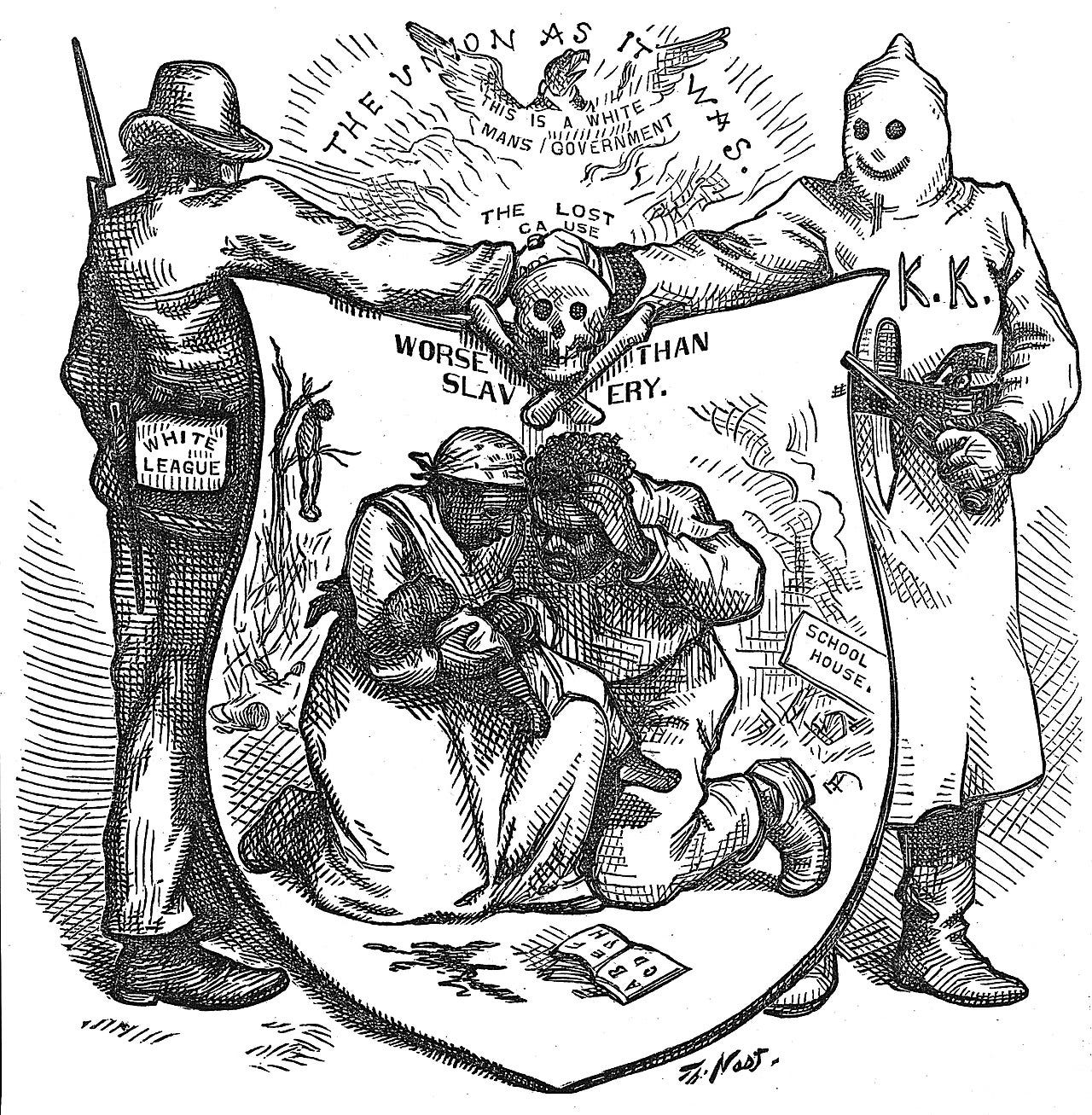
During Reconstruction, Black people thrived.
Black men were granted voting rights and were elected to political offices including seats in the U.S. Congress, Black families acquired land and started farms, and communities built churches and schools.4
But the backlash came quickly. Angry Confederates responded with “violence ranging from unlawful incarceration and voter intimidation to lynching and mass shootings.”5 For 12 years after the war, white progressives in the Republican Party continued to fight to win and protect the rights of Black freedmen against this violent backlash. Federal troops remained in the South, arresting Klansmen, preserving order, and enforcing the new civil rights laws.
But in 1876, while his presidential election was being contested, Republican Rutherford Hayes struck a deal with Southern Democrats: to prevent them from blocking the electoral votes he needed for inauguration, he promised to withdraw the remaining federal troops from the South. Thus, the progressive white folks won the Presidency, and gave up on Black people in the South.
We know too well what happened next – lynching, Black codes, convict leasing, poll taxes, and then Jim Crow. Between 1870 and 1901, 22 Black men served in Congress. And then there were none. As Dr. W.E.B. Du Bois put it, “The slave went free, stood a brief moment in the sun, then moved back again toward slavery.”6
After the Civil Rights Movement: the War on Crime and Mass Incarceration
Although I’ll be adding a third racial backlash in a moment, the reality is that we continue to live in this second one.
Black folks won enormous progress after decades of toil during the Civil Rights Movement. Progressive white folks contributed to the cause. But they did even more to hold it back.
Even while the Movement was gaining momentum, in his Letter from Birmingham Dr. King described how the lack of commitment from white people posed a huge obstacle for racial justice:
I have almost reached the regrettable conclusion that the Negro’s great stumbling block in the stride toward freedom is not the White citizens’ “Councilor” or the Ku Klux Klanner, but the white moderate who is more devoted to “order” than to justice … Shallow understanding from people of good will is more frustrating than absolute misunderstanding from people of ill will. Lukewarm acceptance is much more bewildering than outright rejection.7
For decades, the lukewarm acceptance of white moderates meant that Black folks kept losing. And still, led by Dr. King and less celebrated heroes like Fannie Lou Hamer, they persevered.8 Eventually, they won. The crown jewel in that victory was the Voting Rights Act of 1965.
But after the successes of the Civil Rights Movement, it did not take long for wealth and power to push back. In 1968, Richard Nixon ran for President on the platform of “restoring law and order.” Once in office, Nixon launched an all-out “War on Crime.” Years later, Nixon’s aide John Ehrlichman would explain this political strategy:
The Nixon campaign in 1968, and the Nixon White house after that, had two enemies: the antiwar left and Black people. You understand what I’m saying? We knew we couldn’t make it illegal to be either against the war or Black, but by getting the public to associate the hippies with marijuana and Blacks with heroin, and then criminalizing both heavily, we could disrupt those communities.9
Nixon’s “War on Crime” became Reagan’s “War on Drugs,” then peaked with Clinton’s “Three Strikes.” All of it was racial hierarchy coded as legal “reform.”
The result is America’s notorious system of mass incarceration – “the New Jim Crow.” “Nearly two million people, disproportionately Black, are living in prisons and jails instead of their communities. This contrasts sharply with the early 1970s, when this number was 360,000.”10
This backlash after the hard-won victories of the Civil Rights Movement happened because liberal Democrats fell for the trick – “criminals” became code for race, and white progressives like Bill Clinton (and most of us who voted for him) fell for the bait. Clinton’s 1994 federal sentencing guidelines were ridiculously racist. These “three strikes” mandatory guidelines forced federal judges to imprison tens of thousands of people for minor possession charges. And most of the people serving those sentences were Black and brown. States around the country adopted similar sentencing standards, and mass incarceration exploded.
After George Floyd: From “Racial Reckoning” to Wrecking Civil Rights
And that brings us to the current backlash. We all watched the video of Derek Chauvin grinding his knee on the neck of George Floyd over an agonizing 9 minutes and 29 seconds. This reawakened the racial empathy of white Americans that systems of wealth and power had coaxed to sleep. Through a pandemic, we rallied through 2020’s “Summer of Racial Reckoning.” We demanded systemic reform – or even the outright abolition of current systems of policing. Corporations made bold promises, and Diversity, Equity, and Inclusion programs proliferated across all types of American institutions.
But then came MAGA. White Democrats have struggled to understand, much less respond, to this authoritarian shift in power. Black and brown folks have seen it all before, and knew it was coming. They just didn’t have the power to stop it, without the full buy-in of clueless white allies like me. Folks who believed Trump would never win. Folks who thought our courts would protect us.
In 2016, registered Democratic voters were more likely to stay home than registered Republicans. Some of that failed Democratic turnout happened in key states, including Ohio, Iowa, and Wisconsin.11 According to post-election polling, if both Republicans and Democrats had turned out at the same rate, Hillary Clinton would have been President.12 In addition to low voter turnout, about 1.5 million voters – overwhelmingly white progressive folks – chose to vote for third party candidate Jill Stein.
I remember one of my Black friends pleading with white people on Facebook during the 2016 campaign: “Y’all better go get your cousins.” I didn’t do that. Neither did the rest of us. If white “allies” had just listened to Black voices, Trump would never have won.13
In Trump’s first term, he appointed three Supreme Court justices – Neil Gorsuch, Brett Kavanaugh, and Amy Coney Barrett. Callais was a 6-3 decision in which all three of those justices were in the majority. Complacency from white progressives allowed wealth and power to snatch back the victory that people like Fannie Lou Hamer worked so hard to win.
This post-2020 backlash has been gaining momentum for years, at the same time white Americans’ support for racial justice has waned. Texas and other Republican states outlawed both DEI programs and teaching the truth to children about our country’s racial history. Then, once Trump started his second term and issued threats, corporations stampeded away from DEI.
White progressives have been the weak link because we have never taken ownership of the problem of unwinding the false stories of race and white superiority. I lived most of my life sympathetic with People of Color about racial discrimination. I believed I was an “ally.” But, in my core, I also believed race was somebody else’s problem. So long as white folks continue to believe that, we will continue to retreat from the cause at the first signs of despair, and we will be tricked into complacency whenever it’s comfortable and convenient.14
And so today we live with the horrors of ICE and Border Patrol stealing brown people away, and murdering with impunity those like Renee Good and Alex Pretti, who dare to stand against them.
And we must also – somehow – live with the Supreme Court’s decision in Louisiana v. Callais.
This work is hard. Despair is easy, as is settling back into our comfortable white lives. Historically, this is what we have eventually done. That’s how the white wealth and power backlashes have been able to unwind racial justice progress.
But we don’t have to fall into that same pattern. A path forward exists. We don’t have to continue to be the weak link. Next week we’ll talk about what Callais has broken, and how we can work together to fix it.
John Kelly, “Bryan Stevenson to Advocates: ‘Hopelessness Is the Enemy of Justice,’” The Imprint (Nov. 26, 2024) https://imprintnews.org/youth-services-insider/bryan-stevenson-advocates-hopelessness-enemy-justice/256483 (accessed May 2, 2026).
(accessed May 2, 2026).
Kolumn Magazine, “Bryan Stevenson and the Long Work of Repair,” Kolumn Magazine (April 6, 2026) (characterizing the career of Bryan Stevenson) https://www.kolumnmagazine.com/2026/04/06/bryan-stevenson-and-the-long-work-of-repair/ (accessed May 2, 2026).
National Museum of African American History and Culture, “Make Good the Promises: Reconstruction and Its Legacies,” (Sept. 21, 2021) https://nmaahc.si.edu/about/news/national-museum-african-american-history-and-culture-opens-new-exhibition-make-good (accessed May 2, 2026).
Id.
W.E.B. Du Bois, Black Reconstruction:An Essay Toward a History of the Part which Black Folk Played in the Attempt to Reconstruct Democracy in America, 1860–1880 (1935) Kindle ed. at 46.
https://billofrightsinstitute.org/primary-sources/letter-from-birmingham-jail/ (accessed May 2, 2026).
The original interview with Ehrlichman was conducted in 1994, but first published by Harper’s magazine in 2016. https://harpers.org/2016/03/introducing-the-april-issue-2/ (accessed Oct. 27, 2025).
Ashley Nellis and Sabrina Pearce, “Mass Incarceration Trends,” The Sentencing Project (April 9, 2026) https://www.sentencingproject.org/reports/mass-incarceration-trends/ (accessed May 2, 2026).
PBS News, “What Does Voter Turnout Tell Us About the 2016 Election,” (Nov. 20, 2016) https://www.pbs.org/newshour/politics/voter-turnout-2016-elections (accessed May 4, 2026).
Harry Enten, “Registered Voters Who Stayed Home Probably Cost Clinton the Election,” fivethirtyeight.com (Jan. 5, 2017) https://fivethirtyeight.com/features/registered-voters-who-stayed-home-probably-cost-clinton-the-election/ (accessed May 4, 2026).
Black voter turnout also declined in 2016, but there’s evidence that voter suppression played a significant role — 14 states enacted new voting restrictions for the first time in a presidential election. See Brennan Center for Justice, “Election 2016: Restrictive Voting Laws by the Numbers,” (Sept. 28, 2016) https://www.brennancenter.org/our-work/research-reports/election-2016-restrictive-voting-laws-numbers (accessed May 4, 2026). Notably, the Supreme Court paved the way for these new voting restrictions in Shelby County v. Holder in 2013 – the last time the Court significantly hollowed protections in the Voting Rights Act.
This is why the Healing White History project exists. https://healingwhitehistory.substack.com/p/race-is-my-problem-heres-how-i-finally?r=e2z7c
In the VRA case, the way the explicit intent and language of Congress, from the original bill to later amendments, was brushed aside is breathtaking and clearly demonstrates the hypocrisy of these right wing justices.
This is reflective and sincere. If there is hope for our progress, it lies in awareness and responsibility like this…